How Did I Forget Myself?
8-10 min read
Prefer to listen?
You can listen to this reflection here, or continue reading below.
We don’t lose ourselves all at once.
It happens quietly, in the movement of attention. In the small, ordinary moments you don’t even register.
Reaching for your phone and not remembering why. Starting a thought and forgetting where it was going. Sitting down and realizing you’ve been elsewhere for a while. For a brief moment, there is a gap… That gap is what I know as the absence of presence.
And then life continues.
The way attention leaves the body. The way it scatters into everything else. And we don’t always follow it back.
And slowly, without noticing, we start asking a different question.
Not “Who am I?”
But… how did I forget myself?
For a long time, I thought the question was: Who am I? It seems to be one of the oldest questions we ask ourselves.
We ask it after loss. After illness. After becoming a parent. After a career that no longer fits. After relationships change. After something interrupts the life we thought we knew.
Eventually, many of us arrive there.
Who am I?
But lately I’ve been wondering if another question comes first.
How did I forget myself?
Because I don’t believe we arrive here overnight. We don’t lose ourselves all at once. It’s more like a gradual forgetting through where attention repeatedly goes. Work. Expectations. Productivity. Fear. Survival. Achievement. Roles. The identities we inherit. The identities we build. The identities we try to hold together.
Little by little, attention keeps returning to the same places, and we invest everywhere else.
And eventually, we no longer know what it feels like to be home within ourselves.

Where Attention Goes, Energy Gathers
You’ve probably heard the phrase: “Where attention goes, energy flows.” I find myself saying it differently. Where attention goes, energy gathers.
Not because attention is metaphorical, but because attention is formative. Attention isn’t only movement.
It is investment.
Whatever you repeatedly attend to becomes familiar. What becomes familiar begins to feel safe. What feels safe gradually becomes the pattern through which we live.
Over time, those patterns become so familiar that we mistake them for who we are.
We begin to say… This is just my personality. I’ve always been this way. I’m an anxious person. I overthink. I’m just busy. I can’t slow down.
But what if what we call personality is simply the long-term shape of gathered attention?
Losing Relationship with the Field
I don’t think forgetting ourselves means losing some hidden, authentic version of who we are. I think it means losing relationship with the place from which life is actually experienced.
The body. The breath. The senses. Awareness. Presence.
In yoga, this would be described as a loss of continuity with the field of experience itself.
Looking back, I don’t think I forgot myself all at once. I was living with chronic pain. I was trying to understand why my body felt like it was failing me, and every answer I found pulled me further into thinking. The more I searched, the less I felt.
My body became something I analyzed rather than inhabited.
And slowly, I lost relationship with it.
The body didn’t disappear, but attention no longer remained with it long enough to be known. We become so practiced at living outwardly that we stop noticing the quiet place from which experience arises. That place doesn’t disappear because it’s gone. It disappears from relationship because attention is elsewhere.
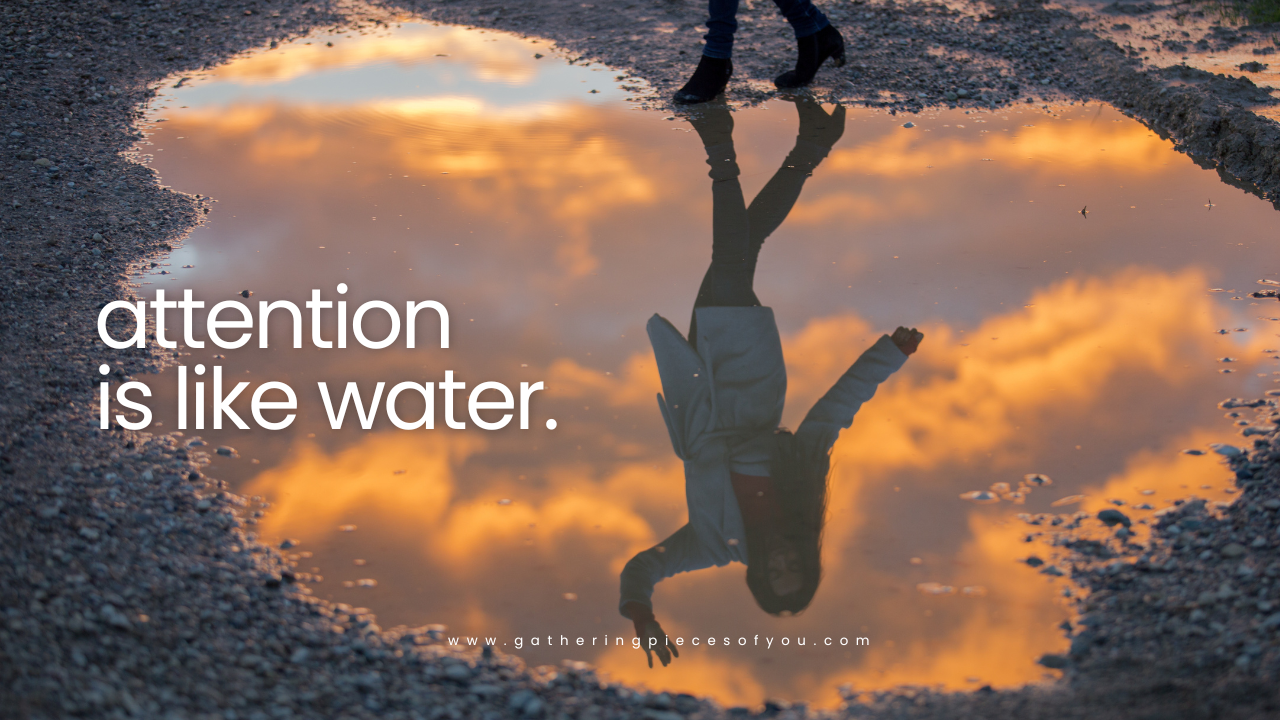
Attention is like water.
And the system it moves through is not flat. It has depth. It has pathways. It has places where it moves easily… and places where it gathers.
If we imagine the body as a kind of living root system, then attention is constantly moving through it.
Sometimes it flows freely. Sometimes it meets resistance. Sometimes it gathers in one place long enough that it begins to shape the direction of future movement.
And this is where things become important because attention doesn’t only move.
It learns the shape of where it has moved before.
So, when attention is drawn outward… into thought, into interpretation, into meaning, it is not starting fresh each time. It is moving through a system that already has a direction. And thought is often where we notice this movement last.
But thought is not where it begins.
By the time a thought becomes clear enough to notice, something has already happened… the body has already shifted, the breath has already changed, attention has already moved, and the system has already organized itself around that movement
Thought isn’t the origin of experience.
It is the reflection of an already-formed direction of attention.
So, when we try to change experience by working only with thought, we are working at the surface of something much deeper. We are trying to redirect water at the point where it has already pooled.
But the pooling didn’t begin there.
It began earlier… where attention first entered the system.
And if we stay with the image of a root system, then we can begin to see this more clearly. Water will always take the shape of the channels that are already open. If a pathway is repeated, it deepens. If a pathway is ignored, it slowly closes.
And over time, the system begins to feel like it has “fixed patterns.”
But what we are really noticing is not fixed identity. It is repeated direction of flow. Not metaphorically. Structurally.
Yoga Asked Me a Different Question
When I first came to yoga, I thought I was looking for answers. Who am I? What is wrong? How do I fix this?
But over time, yoga began to ask something different. Not… who are you?
But… where has your attention been gathering?
This question changed everything, because if attention can gather around fear, it can also gather around presence. If it can become conditioned toward distraction, it can also become conditioned toward awareness. If it can scatter, it can also gather.
This is what yoga begins to reveal directly… not conceptually.
When attention is scattered, it is like water poured into too many vessels. Nothing is lost, but nothing is held long enough to reflect clearly.
What happens in your body when attention gathers again?
Gathering Pieces of You
I don’t believe we are broken. And I don’t believe we need to become a better version of ourselves. That’s not what this work suggests, because the pieces were never truly lost.
Attention simply became scattered.
Yoga, in this sense, is the practice of gathering attention until relationship with ourselves is restored. Not as an idea, but as lived continuity.
We don’t become ourselves through effort or force.
We return… again and again… and again and again.
Until presence becomes more familiar than absence. Until the body is no longer somewhere we visit, but somewhere we live. Until fragmentation begins to soften into coherence.
Continuity and What Was Never Lost
This is what remembering is.
We gather the attention that has been scattered across everything we thought we had to be. Until what remains is what was always here. We don’t discover a hidden self. We return to the place where experience is actually being lived.
And that place is never elsewhere.
Only unnoticed.
State Before Thought
You don’t need to hold onto anything from this reflection, but you might stay with one simple question as you move through the rest of your day.
What state am I in right now?
Not as a way to correct yourself, but simply to notice.
Because before thought appears… before interpretation begins… before meaning is formed… there is already a living condition through which life is being received.
And most of the time, we don’t meet life through thought itself.
We meet it through the state we are in… and thought arrives later to explain what has already been felt.
So, maybe the practice isn’t to think differently first, but to return, gently, to the place where experience is actually happening.
The body.
The breath.
The quiet organization of attention.
And from here, thought begins to change on its own. Not through force, but through clarity.
This is what I mean by state before thought.
And maybe, for today, that is enough to notice.
Slow down.
Gather yourself.
And return to what is true.